

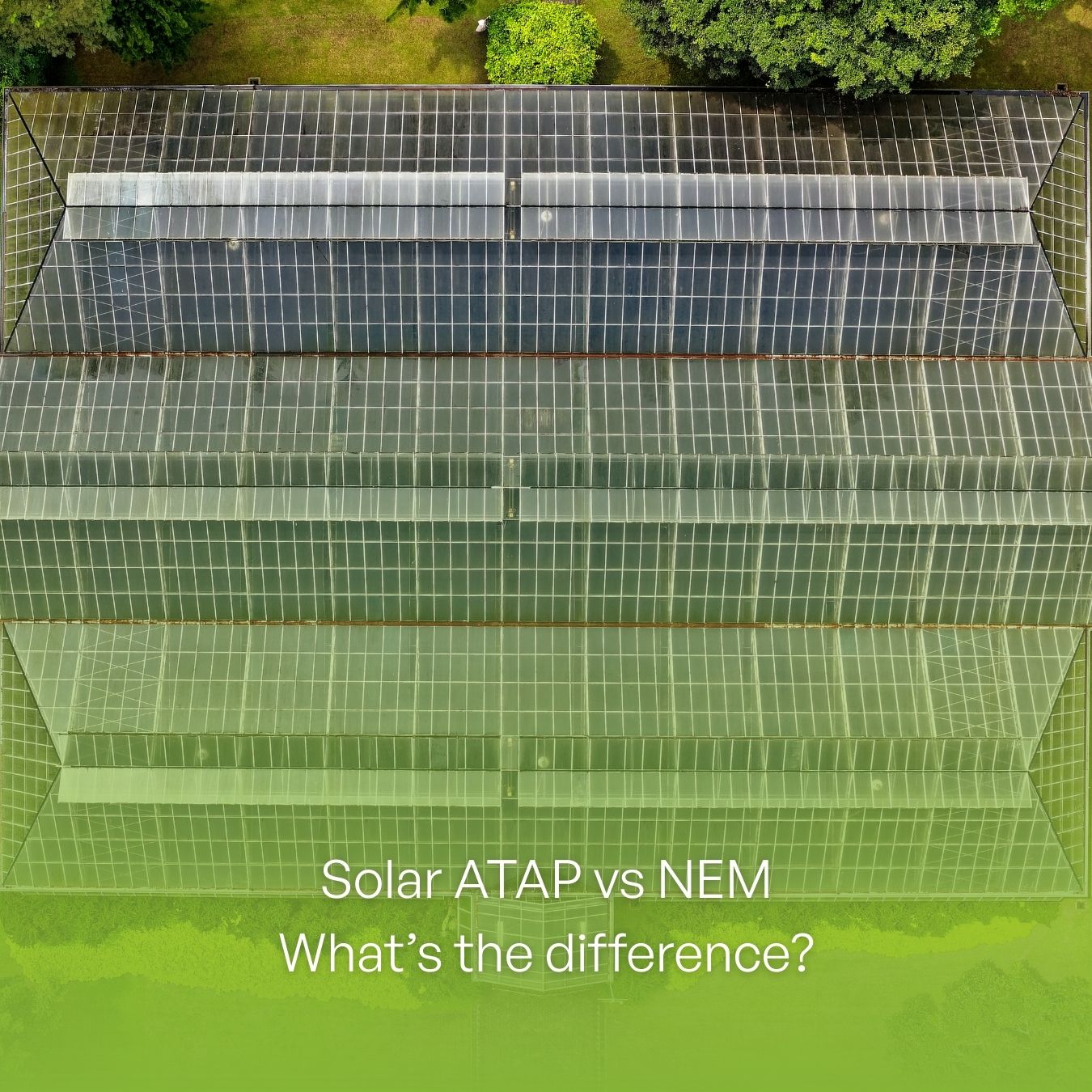
Malaysia’s rooftop solar landscape for businesses has primarily revolved around two mechanisms: Net Energy Metering (NEM) and the newer Solar Accelerated Transition Action Programme (Solar ATAP).
While both enable organisations to deploy rooftop solar, they are fundamentally different in design philosophy, risk exposure, and operational outcomes. Understanding these differences is critical for commercial, industrial, and government decision-makers.
The most important distinction lies in how excess solar energy is treated.
This shift changes solar from a billing optimisation tool into an energy usage optimisation strategy.
Under NEM, system sizing historically leaned toward maximising rooftop capacity to generate higher export credits. This occasionally resulted in oversized systems that depended heavily on regulatory support.
Solar ATAP introduces stricter engineering discipline:
For factories, offices, and institutional buildings with consistent daytime loads, this approach aligns solar generation more closely with real operational needs.
NEM operates as an incentive-based framework. Its economics are sensitive to:
Solar ATAP reduces this exposure by:
For organisations making long-term capital investments, this distinction significantly affects risk modelling and financial certainty.
Commercial and government facilities typically exhibit:
These characteristics naturally favour Solar ATAP. While residential users may benefit more from export-heavy schemes, ATAP’s structure aligns better with institutional energy behaviour and governance expectations.
Conclusion:
Solar ATAP and NEM serve different strategic purposes. For commercial, industrial, and government entities, the shift toward Solar ATAP reflects a broader move toward self-reliance, engineering accuracy, and reduced policy dependency. Understanding these differences allows organisations to adopt rooftop solar not just as a cost-saving tool, but as a resilient energy asset.
Sources:


Guide
Malaysia’s rooftop solar landscape for businesses has primarily revolved around two mechanisms: Net Energy Metering (NEM) and the newer Solar Accelerated Transition Action Programme (Solar ATAP).
While both enable organisations to deploy rooftop solar, they are fundamentally different in design philosophy, risk exposure, and operational outcomes. Understanding these differences is critical for commercial, industrial, and government decision-makers.
The most important distinction lies in how excess solar energy is treated.
This shift changes solar from a billing optimisation tool into an energy usage optimisation strategy.
Under NEM, system sizing historically leaned toward maximising rooftop capacity to generate higher export credits. This occasionally resulted in oversized systems that depended heavily on regulatory support.
Solar ATAP introduces stricter engineering discipline:
For factories, offices, and institutional buildings with consistent daytime loads, this approach aligns solar generation more closely with real operational needs.
NEM operates as an incentive-based framework. Its economics are sensitive to:
Solar ATAP reduces this exposure by:
For organisations making long-term capital investments, this distinction significantly affects risk modelling and financial certainty.
Commercial and government facilities typically exhibit:
These characteristics naturally favour Solar ATAP. While residential users may benefit more from export-heavy schemes, ATAP’s structure aligns better with institutional energy behaviour and governance expectations.
Conclusion:
Solar ATAP and NEM serve different strategic purposes. For commercial, industrial, and government entities, the shift toward Solar ATAP reflects a broader move toward self-reliance, engineering accuracy, and reduced policy dependency. Understanding these differences allows organisations to adopt rooftop solar not just as a cost-saving tool, but as a resilient energy asset.
Sources:
Reach out to us

-01.png)


